 Sahni
Sahni Premium
How Coach picks your next step.
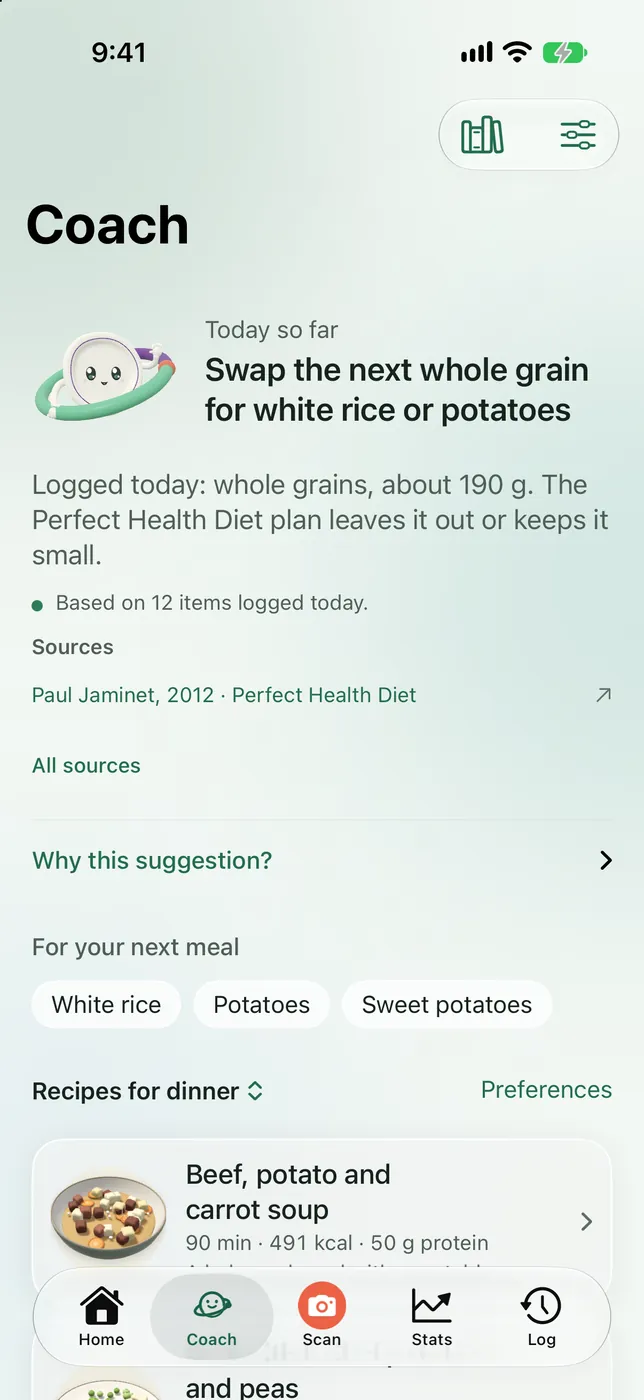
Coach reads what you've logged, picks one thing to do next and shows the numbers and the sources behind it. Fixed rules in the app make the choice; Apple's on-device model only puts it into words.
What Coach reads
Coach looks at your targets, what you've logged today and the other days you logged this week. Food groups come from the names of the items you saved, such as a starch, a meat or a vegetable, so a photo, a barcode and a typed meal all count the same way.
A nutrient is only judged when the foods that carry an estimate for it make up at least 60% of the day's calories. Below that, Coach doesn't call it low. Weekly reads use the days you logged, so a day you didn't log isn't counted as an empty one.
The order it checks things
Coach goes down this list and stops at the first thing that applies, so you get one suggestion at a time, each with its reason in numbers and how much of the day it's based on.
- If your profile mentions a condition a clinician should plan for, Coach holds your targets at maintenance, shows what you log without judging it and suggests nothing else.
- If you've logged little or nothing today, it suggests building your next meal around protein, a starch and vegetables.
- If a food your eating style leaves out or keeps small is adding up today, it suggests a swap for the next one, such as white rice or potatoes in place of bread. Every style keeps the book's list small: grains other than rice, added sugar, beans and peanuts, and seed oils.
- If free sugars pass 5% of your calorie target, it suggests whole fruit instead.
- If you're short on protein or fiber, it names a food that carries it.
- If part of the plate is missing, it names that part. The book's plate is a safe starch such as potatoes or white rice, a meat or fish, vegetables and a fat-based sauce.
- If sodium is well past the safest range for how much you've eaten, it points out that cured meats, salty sauces and packaged snacks carry most of it.
- If you've logged two or more ultra-processed foods, it suggests looking for a label without wheat, sugar or seed oils next time.
- If you've had fewer than five different vegetables this week, it suggests a new one.
- If none of these apply, it tells you to keep going.
On a day you're over your calorie target, Coach adds one line: plan the next meal as a normal one, there's nothing to make up. Each suggestion links the passages it rests on: Perfect Health Diet for the foods and amounts, and the guidelines listed below where a condition calls for them.
Rules it always keeps
- It never suggests eating less to make up for a day over your target.
- It never names a food your diet, your allergies or the foods you've excluded rule out. A vegetarian or vegan profile keeps beans.
- Processed meat is never suggested. Fresh red meat can be.
- Saturated fat isn't judged.
- With kidney disease there's no protein ranking and no potassium target: the kidney team sets those.
- A ketogenic style is never told to eat fruit.
- Blood results you enter never pick the suggestion and never change your targets.
Ask Coach
You can ask why Coach suggested something. Apple's on-device language model answers, reading your day through tools that can only read. Before you see the answer, Sahni checks it: it has to be about the same suggestion, use no number that isn't in your facts, write no numbers out in words, and say nothing about targets, medicine or eating less. If it fails any of these, you see Coach's own wording instead.
The framework behind your targets
For adults without a condition that needs a clinician's plan, Sahni's targets follow Perfect Health Diet by Paul and Shou-Ching Jaminet (2012). Protein is about 15% of your energy, kept between 200 and 600 kcal a day. Carbohydrate is 600 kcal a day, plus 100 kcal for training when you're moderately active, 200 when very active and 300 for athletes. Fat makes up the rest and never drops under 20% of your energy; when you're losing weight, fat is what comes down. Fiber is about 23 g, scaled to your energy, vitamin C 400 mg and potassium 4.7 g.
Eating styles adjust the plan: Mediterranean, potassium-forward, lower-carb, ketogenic (50 g of carbohydrate) and athlete. Kidney disease, pregnancy and breastfeeding, type 1 diabetes, an eating-disorder history and anyone under 18 get guideline values instead, such as at least 130 g of carbohydrate a day. How your targets are set walks through an example.
Targets that update
With automatic updates turned on, Coach changes your targets for you, within these limits. Steps can raise your activity level but never lower it; only three weeks of exercise minutes from a watch can. A weigh-in from the last 14 days sets the weight the plan uses. Coach waits 14 days after you type in targets yourself and 7 days after any other change to your targets, its own included. When it does change something, it tells you what changed and offers Undo.
Every source Coach uses
These are the sources the app ships with. In the app they're linked from each suggestion, from the plan and from the Sources page in Coach's toolbar.
Books
- Why Calories Don't Count: How We Got the Science of Weight Loss WrongGiles Yeo, 2021
- Perfect Health Diet: Regain Health and Lose Weight by Eating the Way You Were Meant to EatPaul Jaminet, Ph.D., and Shou-Ching Jaminet, Ph.D. (foreword by Mark Sisson), 2012
- ACSM's Exercise Management for Persons With Chronic Diseases and Disabilities, Third EditionAmerican College of Sports Medicine; J. Larry Durstine, Geoffrey E. Moore, Patricia L. Painter, Scott O. Roberts (eds.), 2009
- Exercise Physiology: Theory and Application to Fitness and Performance, Fourth EditionScott K. Powers, Edward T. Howley, 2001
- The New Evolution Diet: What Our Paleolithic Ancestors Can Teach Us about Weight Loss, Fitness, and AgingArthur De Vany (afterword by Nassim Nicholas Taleb), 2011
Clinical guidelines
- 2013 AHA/ACC/TOS Guideline for the Management of Overweight and Obesity in AdultsJensen MD, Ryan DH (co-chairs), Apovian CM, et al., 2013
- Eating disorders: recognition and treatment (NICE guideline NG69)National Institute for Health and Care Excellence, 2017
- KDOQI Clinical Practice Guideline for Nutrition in CKD: 2020 UpdateIkizler TA, Burrowes JD, Byham-Gray LD, Campbell KL, Carrero JJ, et al., 2020
- KDIGO 2024 Clinical Practice Guideline for the Evaluation and Management of Chronic Kidney DiseaseKidney Disease: Improving Global Outcomes (KDIGO) CKD Work Group, 2024
- Seafood Long-Chain n-3 Polyunsaturated Fatty Acids and Cardiovascular Disease: A Science Advisory From the American Heart AssociationRimm EB, Appel LJ, Chiuve SE, Djousse L, Engler MB, Kris-Etherton PM, Mozaffarian D, Siscovick DS, et al., 2018
Dietary reference values
- Dietary Reference Intakes for Energy, Carbohydrate, Fiber, Fat, Fatty Acids, Cholesterol, Protein, and Amino Acids (Macronutrients)Institute of Medicine, Food and Nutrition Board (Panel on Macronutrients et al.), 2005
- Dietary Reference Intakes: Guiding Principles for Nutrition Labeling and Fortification — Appendix C, Reference TablesInstitute of Medicine Committee on Use of Dietary Reference Intakes in Nutrition Labeling, 2003
- Iron — Fact Sheet for Health ProfessionalsNIH Office of Dietary Supplements, 2025
- Vitamin C — Fact Sheet for Health ProfessionalsNIH Office of Dietary Supplements, 2025
Reviews and position stands
- International Society of Sports Nutrition Position Stand: protein and exerciseJäger R, Kerksick CM, Campbell BI, Cribb PJ, Wells SD, et al., 2017
- Evidence-Based Recommendations for Optimal Dietary Protein Intake in Older People: A Position Paper From the PROT-AGE Study GroupBauer J, Biolo G, Cederholm T, et al., 2013
- Effects of tree nuts on blood lipids, apolipoproteins, and blood pressure: systematic review, meta-analysis, and dose-response of 61 controlled intervention trialsDel Gobbo LC, Falk MC, Feldman R, Lewis K, Mozaffarian D, 2015
- A systematic review, meta-analysis and meta-regression of the effect of protein supplementation on resistance training-induced gains in muscle mass and strength in healthy adultsMorton RW, Murphy KT, McKellar SR, Schoenfeld BJ, Henselmans M, Helms E, Aragon AA, Devries MC, et al.; Phillips SM, 2018
Studies
- A new predictive equation for resting energy expenditure in healthy individualsMifflin MD, St Jeor ST, Hill LA, Scott BJ, Daugherty SA, Koh YO, 1990
- Consumption of 2 Green Kiwifruits Daily Improves Constipation and Abdominal Comfort - Results of an International Multicenter Randomized Controlled TrialGearry R, Fukudo S, Barbara G, Kuhn-Sherlock B, Ansell J, Blatchford P, Eady S, Wallace A, et al., 2023
- Gut-microbiota-targeted diets modulate human immune statusWastyk HC, Fragiadakis GK, Perelman D, Dahan D, Merrill BD, Yu FB, Topf M, Gonzalez CG, et al., 2021
- Trial of the MIND Diet for Prevention of Cognitive Decline in Older PersonsBarnes LL, Dhana K, Liu X, Carey VJ, Ventrelle J, Johnson K, et al. (incl. Morris MC, Sacks FM), 2023